

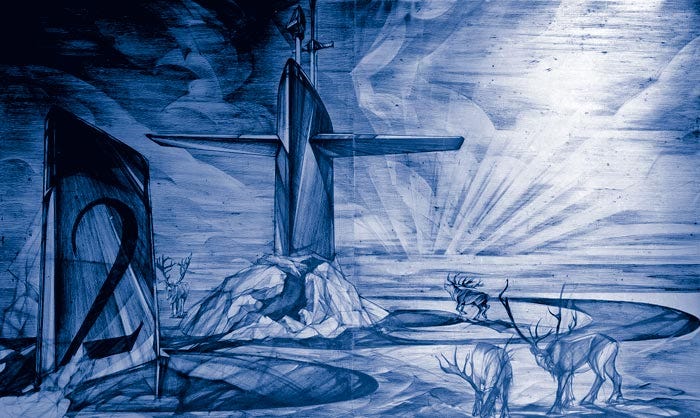
In October 2023, Patriarch Kirill of Moscow presented a church honor to physicist Radiy Ilkaev, declaring that Russia’s nuclear arsenal was created under “ineffable divine providence” and the spiritual protection of St. Seraphim of Sarov.1 Kirill leads the Russian Orthodox Church and Ilkaev is the scientific director of Russia’s principal nuclear weapons facility, making this far from a fringe sermon.
Why does a major Christian leader speak of nuclear weapons as divine instruments? And what does this mean for understanding Russian strategic behavior during an era of heightened nuclear rhetoric? This curious situation is the result of an ideology known as “Russian Nuclear Orthodoxy”. It constitutes a distinct ideological formation, going further from religious nationalism, that shapes Russian strategic culture, legitimizes nuclear coercion, and creates escalation dynamics that Western analysts frequently misread.
This post is largely based on the excellent book “Russian Nuclear Orthodoxy: Religion, Politics, and Strategy” by Dmitry Adamsky, which I highly recommend to anyone looking to read about this topic in further detail.
The Doctrine
Nuclear Orthodoxy rests on two interlocking postulates, formulated explicitly by nationalist journalist Yegor Kholmogorov in 2007:
To remain Orthodox, Russia must be a strong nuclear power
To remain a strong nuclear power, Russia must be Orthodox
This circular logic binds religious identity to nuclear capability with concrete organizational implications.
The doctrine’s foundation is Putin’s February 2007 press conference statement that the Russian Orthodox Church and nuclear arsenal are “the components that strengthen Russian statehood and create the conditions for ensuring the country’s internal and external security.”2 This was the logical conclusion of two decades of church-military integration, now openly stated as policy.
The doctrine incorporates an eschatological layer, frequently propounded by Russian Orthodox clergy and nationalist politicians. Nuclear weapons prevent “premature apocalypse.” Russia’s arsenal protects “Holy Rus” until the Second Coming. The bomb serves as defense against “satanic forces.” In a more specific and recent instance, in March 2024, the World Russian People’s Council, chaired by Patriarch Kirill, issued a decree calling the Ukraine war a “holy war” against “the West that has fallen into Satanism,” positioning Russia as “the world’s ‘Restrainer,’ protecting the world from evil.”3
Origins
The Soviet collapse created existential crisis for Russia’s nuclear complex. Funding evaporated. Brain drain accelerated. Previously celebrated “atomic princes” faced social ostracism, blamed for environmental disasters and arms race costs. In this context, the Russian Orthodox Church (ROC) positioned itself as institutional savior. It offered moral legitimization for work that suddenly lacked state validation, political lobbying for continued funding, and social rehabilitation for stigmatized professions. In 1991, Patriarch Alexey entered the closed city of Arzamas-16 carrying St. Seraphim’s relics. By 1996, St. Varvara was designated patron saint of Strategic Rocket Forces. The covenant between faith and atoms was sealed at the grassroots before it became state policy.
Putin’s rise accelerated the integration. The 2003 Sarov celebrations brought Putin and the Patriarch together at the birthplace of Soviet nuclear weapons. A 2009 presidential decree reestablished military clergy. Under Sergei Kirienko’s leadership at ROSATOM, churches appeared at all nuclear facilities. By the 2010s, Orthodoxy had become central to state ideology. Foreign policy applications followed: religious justifications for Crimea’s annexation, framed as “the Crimean font of Orthodoxy”; Syria intervention presented as protecting Middle Eastern Christians, with “Holy War” rhetoric. The ROC now functions as an arm of Russian foreign policy.
Organizational Reality
The penetration is comprehensive. Drawing from Dmitry Adamsky’s research in Russian Nuclear Orthodoxy:
Every leg of the nuclear triad has designated patron saints. Icons are present in all command posts, including Central Command Posts. Garrison churches exist at every major nuclear base. By 2004, some 2,000 priests were interacting with military personnel, representing 8% of total ROC clergy. Faculties of Orthodox Culture had graduated over 3,000 officers by 2020.
Unlike Western chaplains who maintain operational separation, Russian nuclear clergy participate in missile consecrations, launch ceremonies, combat duty rotations, and operational planning. The Synodal Department calls the Strategic Rocket Forces “the most churched service,” dubbing its priests “strategic pastors.” Priests join submarines on extended operational patrols. Portable churches accompany mobile missile units.
The Sarov mythology reinforces this architecture. Russia’s principal nuclear facility sits on the grounds of St. Seraphim’s monastery. This is treated not as historical accident but divine predestination. The saint’s name, Hebrew for “burning,” is linked symbolically to nuclear fire. Cold War-era nuclear scientists who worked in closed off secret cities were termed “20th century eremites.”
However, this hasn’t been an uncontested notion even within the ROC. A 2020 draft ROC document proposed banning consecration of weapons of mass destruction. But in 2022, the archpriest assigned to the Strategic Missile Forces denied the ban would be adopted.4 Kirill’s October 2023 statement on nuclear weapons as “divine providence” confirms that any such ban remains a dead letter.
Strategic Implications
Nuclear Orthodoxy has observable effects on Russian strategic conduct.
Legitimization of nuclear coercion. The moral framework legitimizes nuclear threats differently than secular deterrence logic. When Putin said in 2018 that Russians “will go to heaven as martyrs” while adversaries “will simply drop dead,” he drew directly from this theological well.5
Public support mobilization. The ROC systematically generates domestic backing for aggressive nuclear signaling, providing political cover for modernization spending and coercive rhetoric.
Professional identity formation. Nuclear personnel are framed as spiritual warriors defending Holy Rus. This shapes institutional culture and, potentially, individual decision-making under crisis conditions.
Russia’s November 2024 nuclear doctrine update should be understood within this framework. The revision lowered the threshold for use from “threat to the very existence of the state” to “critical threat to sovereignty and/or territorial integrity.”6 In Russian strategic thought, “sovereignty” includes spiritual and civilizational dimensions. The religious framing makes expanded nuclear threats morally coherent to domestic audiences.
For Western analysts, several implications follow. If Putin uses religion to enhance nuclear coercion, his actions may resemble “madman theory,” where a leader appears somewhat irrational to make threats credible. The religious framing adds perceived conviction. It is also likely that at a certain level, Russian leadership might genuinely buy into the ideology and hence do perceive stakes differently as compared to the West.
The clergy’s integration into strategic forces also adds an element of operational uncertainty. Does it facilitate order execution through moral legitimization? Or could it create pockets of disobedience if orders conflict with faith? The former seems more likely given self-selection patterns among nuclear clergy, many of whom are converted former officers.
The Big Picture
Nuclear Orthodoxy will likely endure. The penetration of faith into Russia’s nuclear complex runs deep, involves extensive vested interests, and predates Putin’s rise. It will likely outlive him. For practitioners engaging Moscow, this matters concretely. Religion is now integral to understanding Russian nuclear decision-making. Faith-based narratives shape threat perception and strategic culture. The ROC functions as an informal policy actor in national security.
This also offers a case study for thinking about how transformative technologies develop distinct ideological orientations. The nuclear complex’s experience shows how specialized technical communities can develop belief systems that shape their approach to catastrophic risk, in ways that diverge from “rational” models Western analysts assume. Specifically, understanding Russia’s fusion of faith and nuclear power provides essential context for examining Moscow’s positions on autonomous weapons and AI governance, where the same strategic culture shapes emerging technology policy. This is something that I look forward to exploring in later posts.
“Men never do evil so completely and cheerfully as when they do it from religious conviction.” Blaise Pascal
“Nuclear Weapons ‘Saved’ Russia – Patriarch Kirill,” The Moscow Times, October 18, 2023
Putin’s statement at February 1, 2007 press conference, as documented in Dmitry Adamsky, Russian Nuclear Orthodoxy: Religion, Politics, and Strategy (Stanford University Press, 2019), 158-160.
“Russian Orthodox Church declares ‘Holy War’ against Ukraine and West,” Atlantic Council, April 9, 2024.
“Blessed Be the Nukes? Russian Orthodox Recommends End to Ritual for Missiles,” Christianity Today, July 30, 2019; “Nuclear Weapons: What Does Russian Orthodox Church and Its Top Parishioner Believe?,” Russia Matters, August 2022.
“Russia Revises Nuclear Use Doctrine,” Arms Control Association, December 2024; “Russia’s Nuclear Doctrine Amendments: Scare Tactics or Real Shift?,” United States Institute of Peace, January 2025.